
Super Mario Bros. Wonder – Nintendo Switch 2 Edition + Meetup in Bellabel Park review
System: Switch 2
Release date: March 26, 2026
Developer: Nintendo
Publisher: Nintendo
When Super Mario Bros. Wonder landed on the original Nintendo Switch back in 2023, it managed to breathe new life into Mario’s side-scrolling adventures. The game’s exuberant personality – manifested through relentlessly creative stages, impressively expressive animations, and plenty of surprises along the way – led me to write a glowingly positive review, and everything I said at the time remains true today. It’s a singular experience both in the genre, and for Mario, but if you somehow haven’t played it yet… well, your patience may have paid off. With the release of the game’s Switch 2 version, elegantly titled Super Mario Bros. Wonder – Nintendo Switch 2 Edition + Meetup in Bellabel Park, the title receives some new single-player and multiplayer content, optimizations for Nintendo’s latest console, and a smattering of quality-of-life features.
I never really felt like Super Mario Bros. Wonder needed an expansion. To me, the game delivered on just about everything I had hoped it would be at launch, and I would have been happy if Nintendo had simply patched it with a higher resolution for Switch 2. Obviously, since Nintendo decided to go the route of charging $20 for this Upgrade Pack (or $80 for players buying the Switch 2 Edition for the first time), there’s a hope that the extra content included would be substantial enough to warrant the cost. Not every game needs a Nintendo Switch 2 Edition, and this one was not particularly high on my wishlist for that, so as much as I loved the base game I wasn’t necessarily waiting with bated breath for this DLC. The good news is that, all things considered, it’s clear that more effort has been put into this package than some of Nintendo’s other efforts.
The game does run at a higher resolution now, of course, but Super Mario Bros. Wonder was already a beautiful game, so it doesn’t feel like a significant change. Really, the bulk of the new content in Super Mario Bros. Wonder’s Nintendo Switch 2 version is in the expansion’s titular Bellabel Park. This is a new region on the world map that’s available immediately for returning players, and early in the game the new players. It’s split into two areas, depending on what type of experience you’re looking for. The first is the Toad Brigade Training Camp, where players can take challenge stages that remix some of the base game’s levels and concepts in interesting new ways. The second is Attraction Central, which houses a selection of minigames playable either online or via local multiplayer.
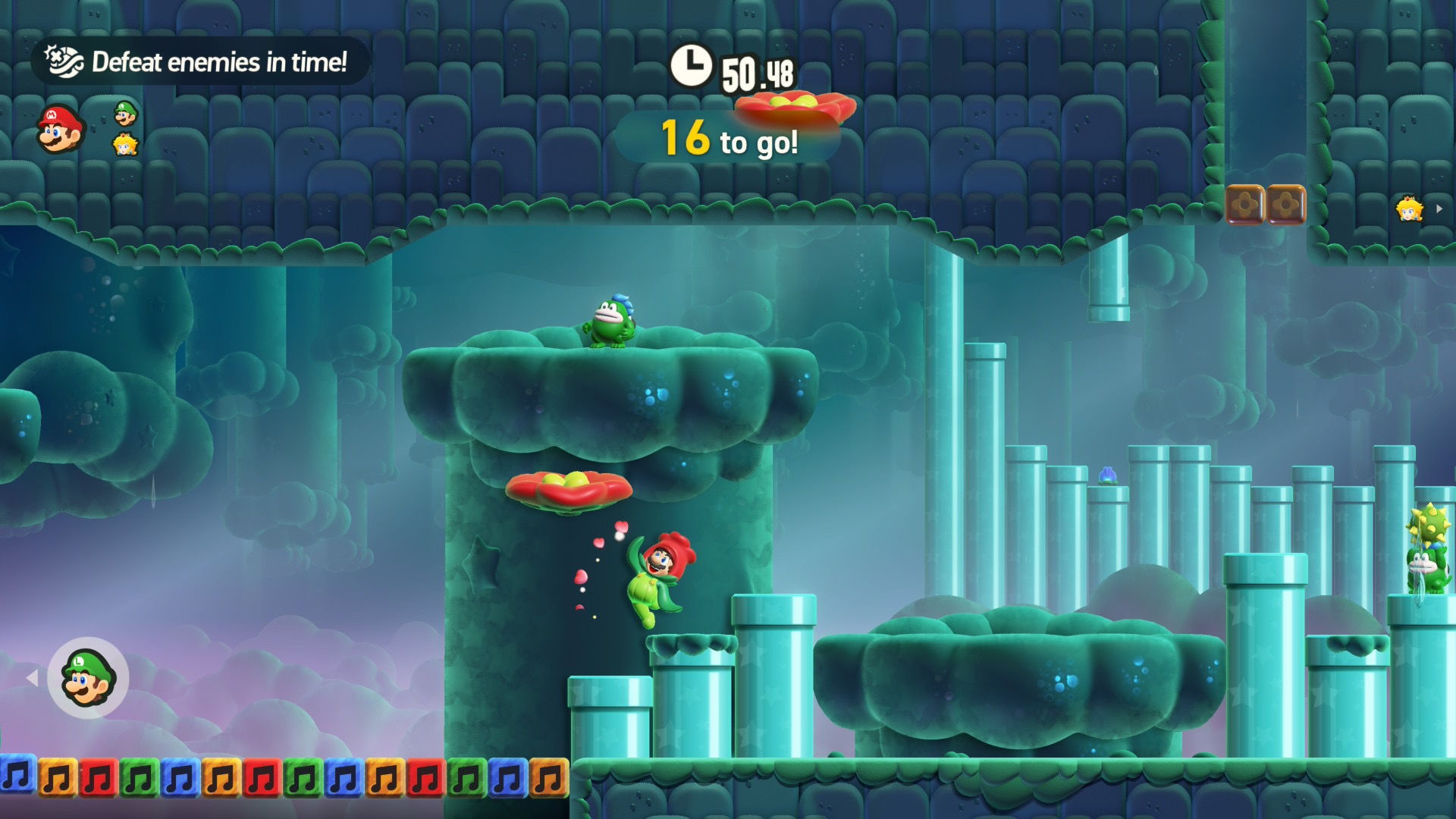
As someone who typically gravitates towards single-player experiences, I decided to take on the game’s new challenge stages first (although it’s worth noting these can also be played in multiplayer, just like the base game’s core levels.) I wasn’t expecting much going in, but was surprised to find that there’s over 70 missions here to tackle. More impressively, despite a good chunk of them sharing similar objectives or mechanics, they manage to feel quite varied, even when playing through them one after another. Make no mistake, these aren’t as robust as the core game’s mainline stages – don’t expect much in the way of new stage layouts, Wonder Flower transformations, or enemies. Rather, these are intended to be quick bursts of challenge to pick up and play, but there’s still potentially about six hours worth of content in this mode alone if you really want to see everything.
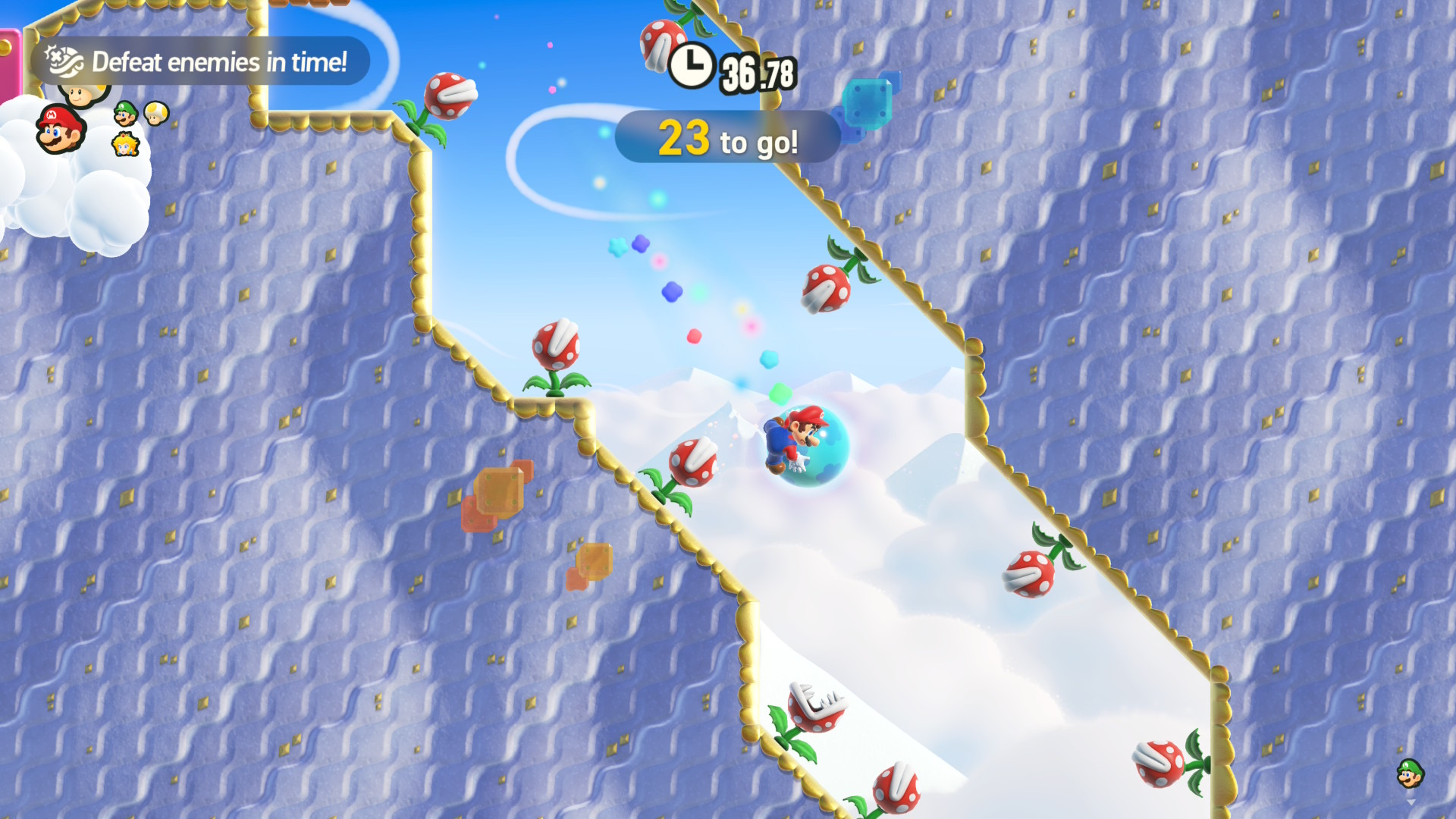
They do get challenging, too. Unlike most stages in the base Super Mario Bros. Wonder game, which focused on wowing through their sheer creative design, this mode is all about ratcheting up the difficulty over time and really testing your ability to learn a stage. Generally, there are a few types of missions to work through. You might need to quickly figure out what the best way is through a stage to collect every coin or take out every enemy, typically under the pressure of a strict timer that leaves little room for error. Alternatively, you might have to make your way through a level while avoiding picking up a single coin, as the game finds ways to make that progressively more difficult. Maybe you’ll have to do it while invisible. Maybe you’ll have to do it while navigating a course that’s 90% pits and 10% solid ground, while also being unable to stop bouncing. There were plenty of stages I got through on my first try, but there were also some gauntlets towards the end that, I kid you not, took me well over a dozen attempts. Certainly, it was a humbling experience for someone who has been playing these games for a few decades now!
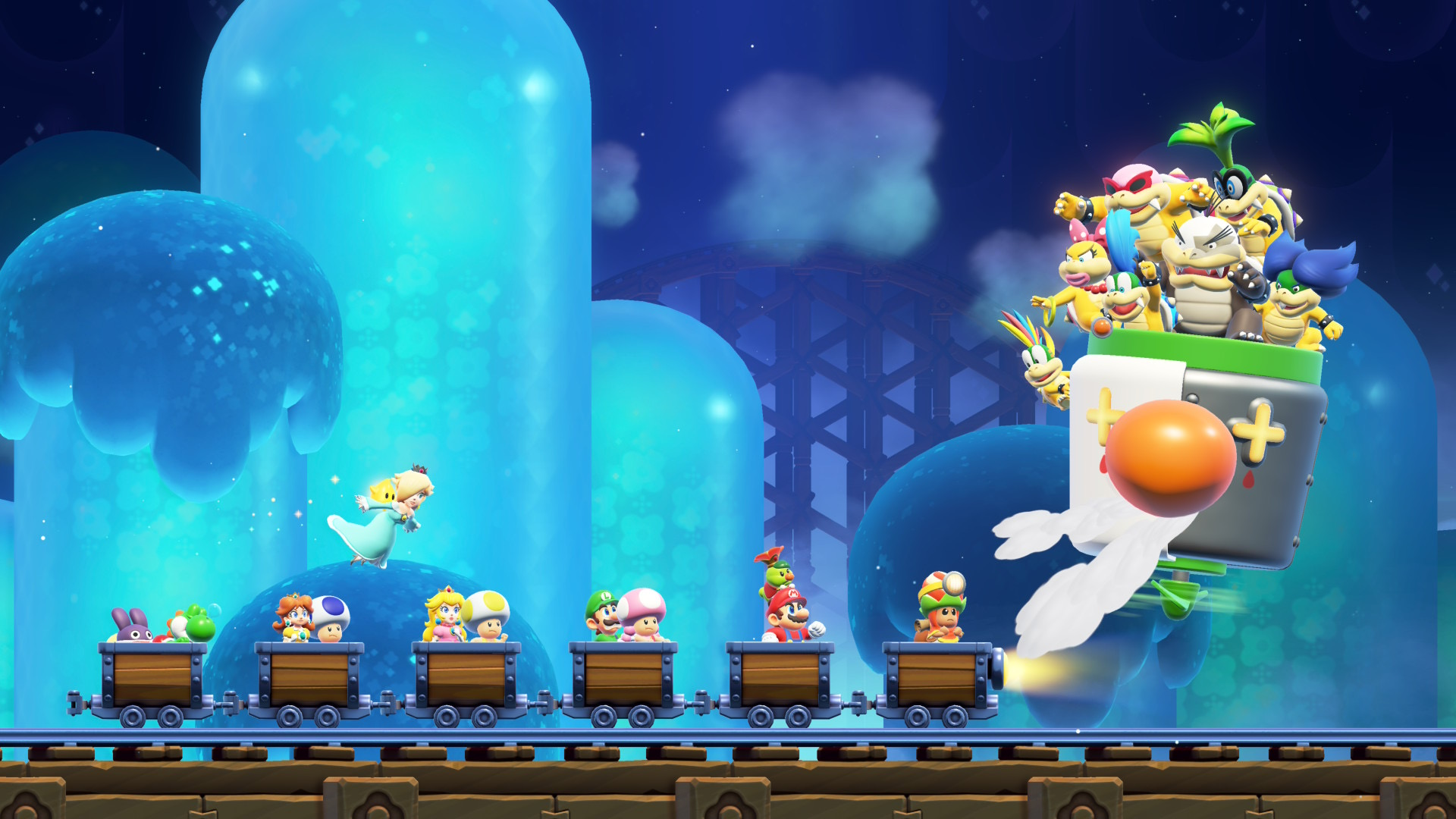
Also playable in single-player are some new boss battles. There weren’t many of these in the game back when it originally released, so I love that they’ve been focused on a bit more. If you’re a longtime Mario fan, you may be familiar with the Koopalings – seven of Bowser’s rowdiest minions, who have a tendency of popping up at inopportune times just to rile things up. Well, they’re back! They stole the Bellabel flowers that are native to Bellabel Park, you see, and that’s an issue because… look, you’ve just got to get them back, okay?
The Koopalings are scattered across each of the game’s main map regions. Once they’re introduced, you can visit them at any time to take them on. Since I had already beaten the main game, I just darted around the world map and tackled the fights back-to-back, which felt a little strange as Mario games don’t typically let players do such a thing. It felt like taking on a boss rush mode, but with lower stakes and fluffy diialouge between encounters. I feel like, in terms of pacing, the experience is probably better for first-time players who will encounter the new battles organically as they progress through the main game, but hey – if you’ve already done everything else, nothing is stopping you from jumping in whenever you’d like.
Fortunately, all of these boss battles are decidedly great – there isn’t a single boring one out of the bunch. Sure, there may be a bit of trial and error involved, but overall these challenges do a great job communicating what the player needs to do to KO the Koopalings, and it all feels just as satisfying to pull off as the rest of Super Mario Bros. Wonder’s challenges. They’re certainly more complex than your average 2D Mario boss encounter. Yes, there are fights where fundamentally, the thing you need Mario to do is stomp on an enemy’s head, but there’s a lot of creativity surrounding that.
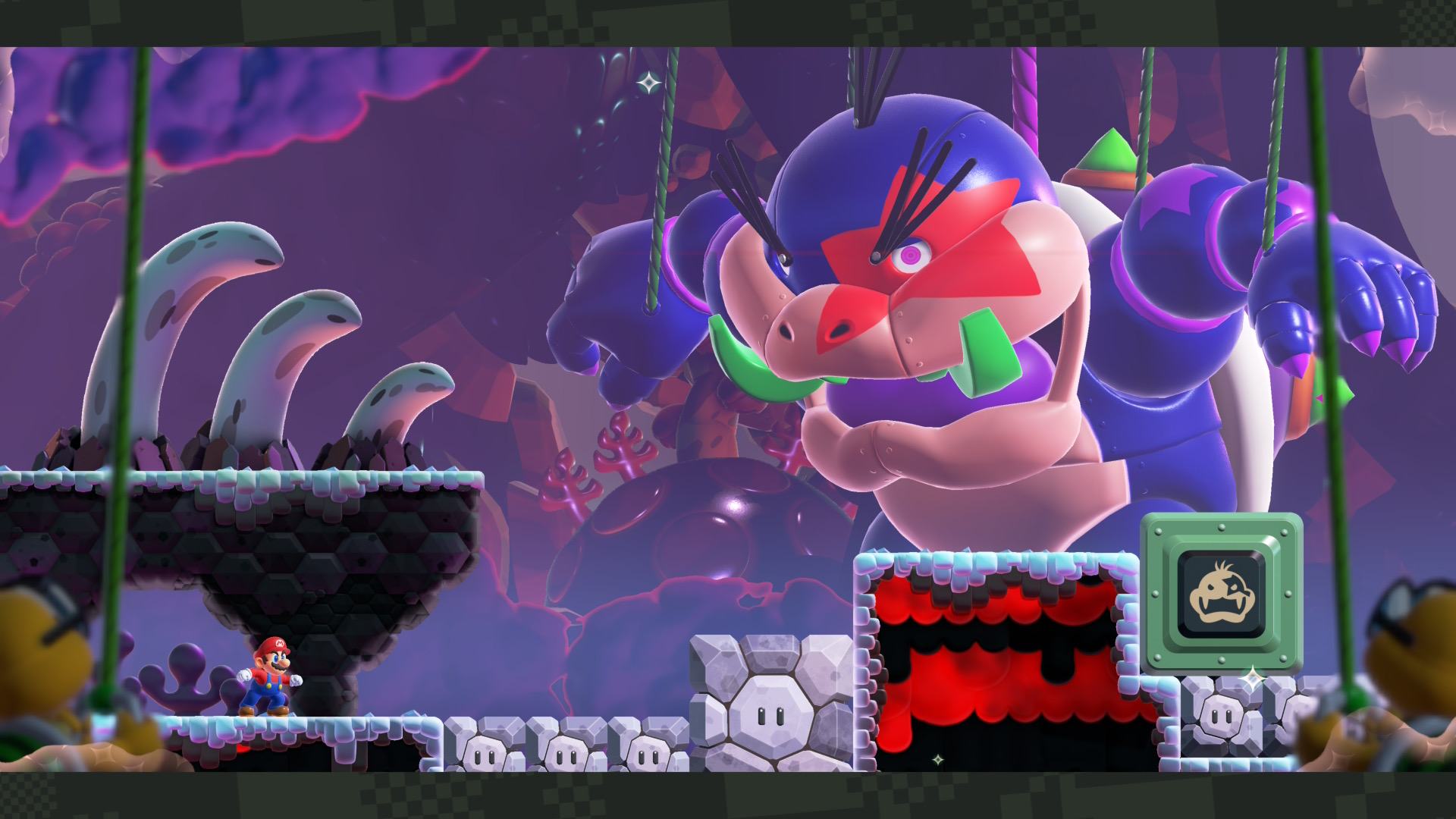
In these battles, the Koopalings are buffed by Wonder Effects, which can result in some impressive, screen-filling encounters. My personal favorite was the fight against Roy, in which he takes control over a crashed pirate ship that, previously, was just a background decoration. I also really enjoyed a fight in which one of the Koopalings is turned into a shockingly big marionette, with enemies in the foreground literally pulling his strings to control him. It’s all really fun stuff, and I don’t think it’s a stretch to say that they’re probably some of the best boss encounters among Mario’s 2D adventures.
Many of Super Mario Bros. Wonder’s new training missions, and a few of its boss battles, are also built around the new power-up introduced in this expansion. The Super Flower Pot item lets Mario launch large flowers into the air, providing a way to attack enemies or break bricks and such from below. It also seems to make him a bit lighter, and lets him do a little mid-air flutter jump that’s similar to how Yoshi maneuvers. At first I thought the projectiles this powerup spews might have been able to be utilized as platforms, but that’s not the case, despite the visual language of the effect implying otherwise. Regardless, it’s a fun new addition, even though it doesn’t fundamentally change the game in any way. It’s a nice continuation of the Flower Kingdom’s theming, too, which was always a bit more on the subtle side in the original game.
As you work your way through the missions, you’ll earn a new type of in-game reward called Bellabel Water. The Poplins – you know, those little plant dudes that live around the Flower Kingdom in this title – basically describe it as magic water, but all you need to know is you use it to water sprouts around Bellabel Park. When you do so, you’ll get various in-game rewards. Unfortunately, I found most of them underwhelming. The most interesting of the unlockables are new Dual Badges. In the base game, you could unlock Badges, which basically acted as modifiers that gave Mario different movement options in stages. The Dual Badges combine some of these abilities into a single Badge, basically opening up new ways to experiment with Marios’ moveset. But as I had already finished the base game, they weren’t of much use, and I didn’t feel a pull to use them in the Toad Brigade Training Missions either. You can also unlock emotes to use in multiplayer, and flowers to decorate Bellabel Park. Not exactly riveting stuff, but it didn’t detract from the game, either.
I feel similarly about some of the game’s other new additions. In terms of characters, players can now choose to play as Rosalina from the Super Mario Galaxy games. It’s a cute nod to the series’ past, but again, it doesn’t fundamentally change the game in any way, even though it’s apparent a lot of care has been given towards animating her just as intricately as was done for the base game’s characters. (Plus, I’m a bit of a purist, so I usually just play as Mario when given the choice.) There are some new options to make the game more accessible to less-experienced players, such as the option to control a Luma during co-op play rather than a traditional character. The key difference here is this character takes on a more of a support role, helping collect coins and such from afar, but generally not being able to interact with levels nearly as deeply. It’s a nice option for kids, I’m sure, but otherwise an unexciting addition. The same can be said for the game’s new Assist Mode, which essentially makes failing a level near-impossible; probably useful for very casual players (of which this series certainly is popular among), but not really a meaningful addition for returning players.
Going into this release, I was a bit worried that the game’s new multiplayer offerings would follow a similar fate. The Nintendo Switch 2 Edition of Super Mario Bros. Wonder adds in a selection of brand new minigames, some of which can only be played online, and some of which can only be played in local multiplayer. Now, I’m not going to pretend like these are the deepest games in the world, or that these are experiences I’m going to frequently return to. Still, there’s absolutely fun to be had, if you’re open to bit of mild chaos.
The minigames really shine brightest in local multiplayer, in my opinion. If you prefer to compete, there’s a solid variety of options. A good chunk of the games are based around collecting things, like seeing who can get the most coins or take down the most enemies. But some of the variants of these challenges are just plain fun, like Get Gobbling, in which players carry around baby Yoshis and try to get them as fat as possible by feeding them fruit and foes. There are a couple games more focused on battling each other like Zap Frenzy, where players launch electrical spires across the screen to try and hit each other. Most of these I only had the chance to play with two players, and we had a good time, but I can imagine things would be significantly more interesting with more people in the mix. There’s maybe about ten of these competitive games, and a number of them are exclusive to local multiplayer. That may rub some folks the wrong way as I don’t think there’s necessarily a great reason for that, but it is what it is.
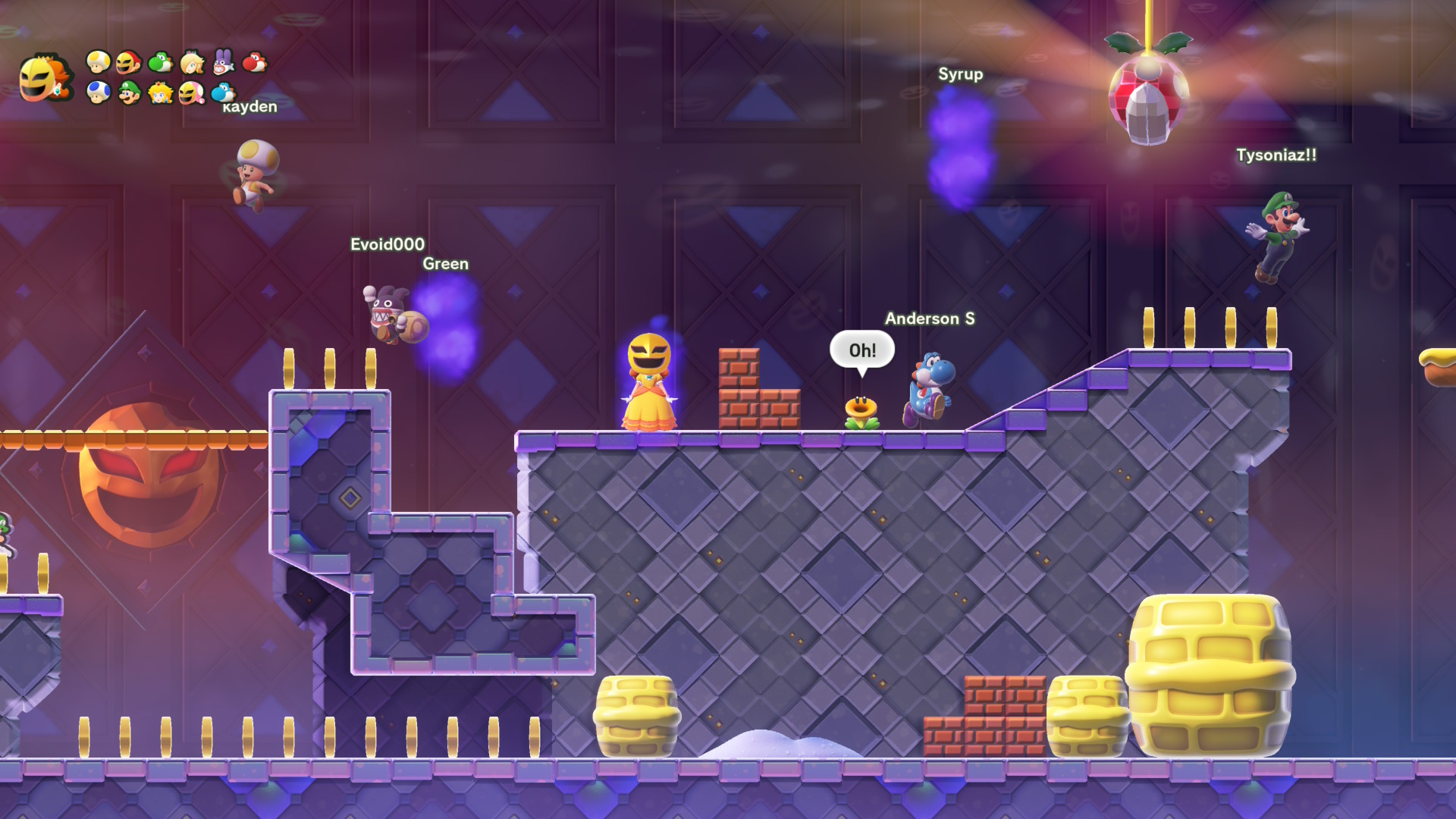
Also exclusive to local multiplayer are cooperative games. These are even stronger than the competitive minigames, in my opinion, as they definitely require some level of communication with whoever you’re playing with, unless you’re just really good at anticipating their next move. For example, in Build Away, one player has to navigate towards the end of a stage while the other player creates a path for them to follow using disappearing blocks (which can be done with mouse controls, too!) This, as you can imagine, resulted in many failures; playing with my wife, I’d expect her to go one way, but perhaps she was thinking differently, or she bounced off an obstacle into the void below before I could catch her. All the while, players are being ribbed by the Talking Flowers reminding us to work together, which is both annoying and funny in the heat of the moment. There are only a few co-op games, but they all felt like this and we had fun trying them all out.
Something I’m appreciative of is that for most of these minigames, it’s possible to play on multiple stages, each with their own layouts and unique attributes. A good chunk of the minigames have more than six! So, even if the sheer quantity of mingles isn’t nearly as big as something like Mario Party, there’s still enough here to help keep things varied enough when playing the same few games over and over with friends. Another fun way to keep things varied is to play the games via an Attraction Tour, which basically just randomly picks games back-to-back, keeping track of player performance in each round. It’s a basic feature, but I’m glad it’s here.
For those wanting to play these new minigames online, the situation is a little less rosy. Surprisingly, there’s far less to do here, and far fewer options for how to play. Most of the game modes in Bellabel Park dedicated for online play are just variants of racing to the end of a course, so the appeal wears off much more quickly, even with the stage variants each game mode enables. The only real exception is Phanto Tag, which is a version of hide and seek where the player can transform into camouflaged objects to try and hide in the environment. That one, unlike the races, can also be played locally on a smaller scale, so really the only thing you are missing out on if you don’t play online are the races.
What’s more baffling is that there’s no way to play Bellabel Park’s multiplayer attractions online with strangers – you have to create or join a room by coordinating with friends. I managed to get in a few sessions by joining a Discord channel dedicated to the game, but it’s a pretty ridiculous hurdle in 2026 to ask of people who just want to play Mario minigames online. Plenty of people only play online games through random matchmaking. Not everyone in my friend circle who plays games owns a Nintendo Switch 2, and of those that do, very few are likely to pick this up and set aside a dedicated time to play minigames in DLC for a Mario game that released in 2023. Even if you do get into a lobby, it’s a bit of a free-for-all once you’re in. Basically, whoever picks a game first determines which game gets played by everyone else in the room. This is how I played six rounds of Phanto Tag back to back against my will. You can get around this if someone sets up an Attraction Tour, but unless you’re coordinating with your friends on voice chat, it’s not a guarantee.

Super Mario Bros. Wonder was already an incredible game, and the extra content added to it via its Nintendo Switch 2 rerelease or Upgrade Pack DLC simply bolts on more charming side-scrolling shenanigans to sink your teeth into. While the lack of new core stages does result in an experience that can sometimes feel a bit recycled, the game’s new challenge level and boss battles are creative and satisfyingly tricky at times, and flesh out the single-player package just enough to feel worthwhile. Simple yet often amusing minigames create new opportunities for couch co-op shenanigans, although the lack of options for online play is a disappointing oversight that lowers replayability. A higher resolution and some small quality-of-life updates geared towards less experienced players are thoughtful additions, but unlikely to excite. Perhaps a bit more meat on the bones of this expansion would have helped satiate Mario’s most ravenous fans, but if all you want is “more Super Mario Bros. Wonder” you’re unlikely to be disappointed.
Super Mario Bros. Wonder – Nintendo Switch 2 Edition + Meetup in Bellabel Park copy provided by the publisher for the purposes of this review.


