
Bubsy 4D review for Nintendo Switch 2 and Switch

System: Switch 2 / Switch (reviewed)
Release date: May 22, 2026
Developer: Fabraz
Publisher: Atari
I don’t need to talk about Bubsy’s standing in the wider gaming community; everyone knows about the bobcats much-maligned original releases during the big platformer mascot boom of the 90s. Still, perhaps in some capacity due to him being the target of many an online game reviewer’s ridicule, he has remained in the cultural zeitgeist. In the last decade, Bubsy has returned to the forefront with a few decent 2D platformers harkening back to his roots, and a collection last year of all his ‘greatest hits’ to get people up to speed ahead of the release of this new title, Bubsy 4D. By far and away, this is the most fun Bubsy title to date and indie developer Fabraz deserve massive credit for getting this bobcat into a place where I can say I thoroughly enjoyed my short but sweet experience with his latest title.
Bubsy 4D’s plot involves the titular bobcat (voiced by Sean Chiplock) going up against a new team of foes, the Baabots, who are cybernetically enhanced sheep that were originally abducted by series villains the Woolies, only to revolt and take rule of the Woolies planet and their tech. Originally uninterested, Bubsy decides to take action when his prized Golden Fleece is taken away from him by the Baabots. He and his friends head to space to get their golden fleece back.
While the majority of Bubsy’s titles are 2D platformers, this one is a sequel to perhaps his weakest title, Bubsy 3D, which as the name would suggest, is a 3D platformer. Although inspiration is definitely drawn from Bubsy 3D, Bubsy 4D has mostly derived it’s mechanics from an array of beloved 3D platformers as well as Fabraz’s previous title, Demon Tides.
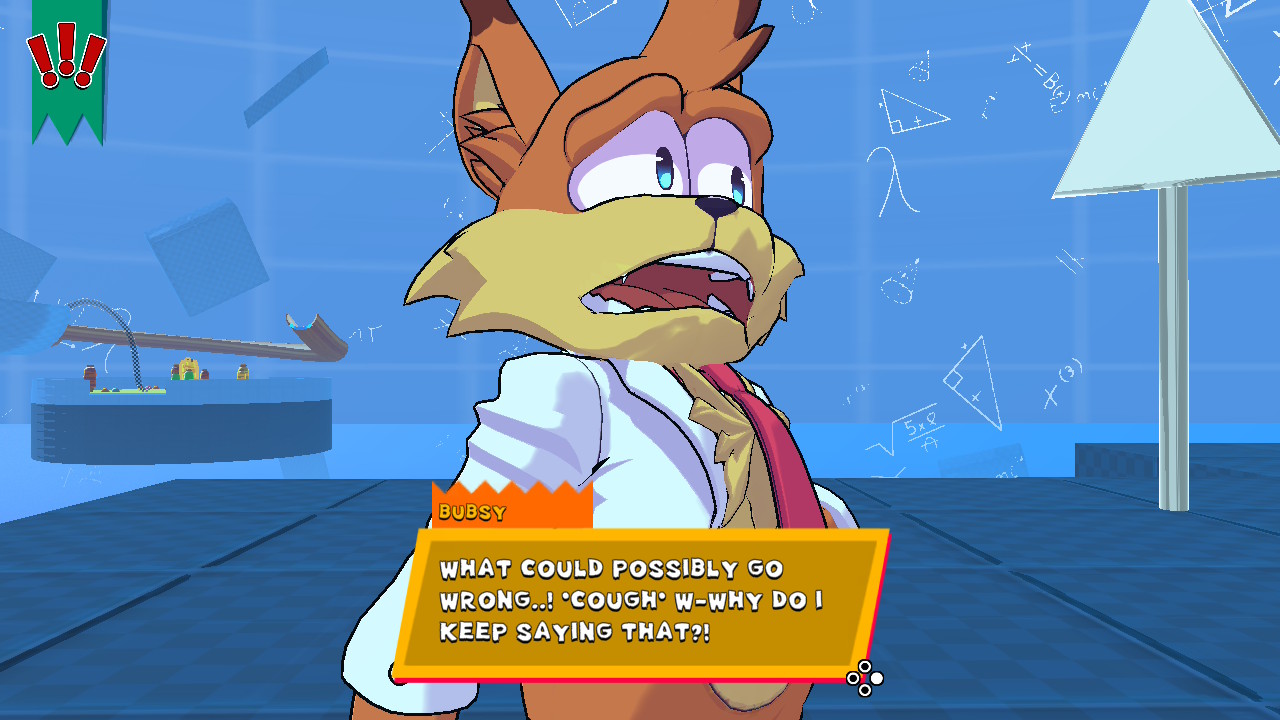
Bubsy 4D can be played one of two ways; as an exploration-based collect-a-thon where the relatively linear stage paths have hidden routes and places a bit in the distance where Bubsy can collect balls of wool, each stage containing 150 in total. That isn’t strictly true, as there are a few Silver Wools that are worth 10 regular wools within the level, that usually come as a reward for thinking outside the box and platforming to somewhere off the beaten path. There is also, in every stage aside from boss stages, a hidden scroll that Bubsy can find which he can then exchange with his niece and nephew for new abilities and helpful improvements to some of his base kit. Bubsy can also trade his wools for different costumes and skins.
The other way to play the game is in the style of a time-trial, where using Bubsy’s array of skills and movement-based actions to zip through a level and beat the time record placed at the bottom of the screen. Those familiar with Crash Bandicoot’s Time Relics will know what I’m talking about here – it feels quite similar. The genius of the level design is that both styles of gameplay feel incredibly fulfilling. To find a balance in the size of stages where being in it for two minutes and being in it for fifteen minutes is equally satisfying is no mean feat.
As is the case with previous titles, the level design for Bubsy 4D is quite abstract; with the fact that Bubsy is traveling through a few different worlds away from home allowing for some pretty unique imagery. The Woolies planet from other Bubsy games returns as the first world, while the next two worlds are wholly original; one based on craft design, with pencils, rulers, measuring tapes and stacks of sheets providing the obstacles Bubsy must manipulate to make it to the goal. The third world is a junk-based planet full of toxic guck, outdated technology and a lot of smaller platforms Bubsy has to take advantage of.
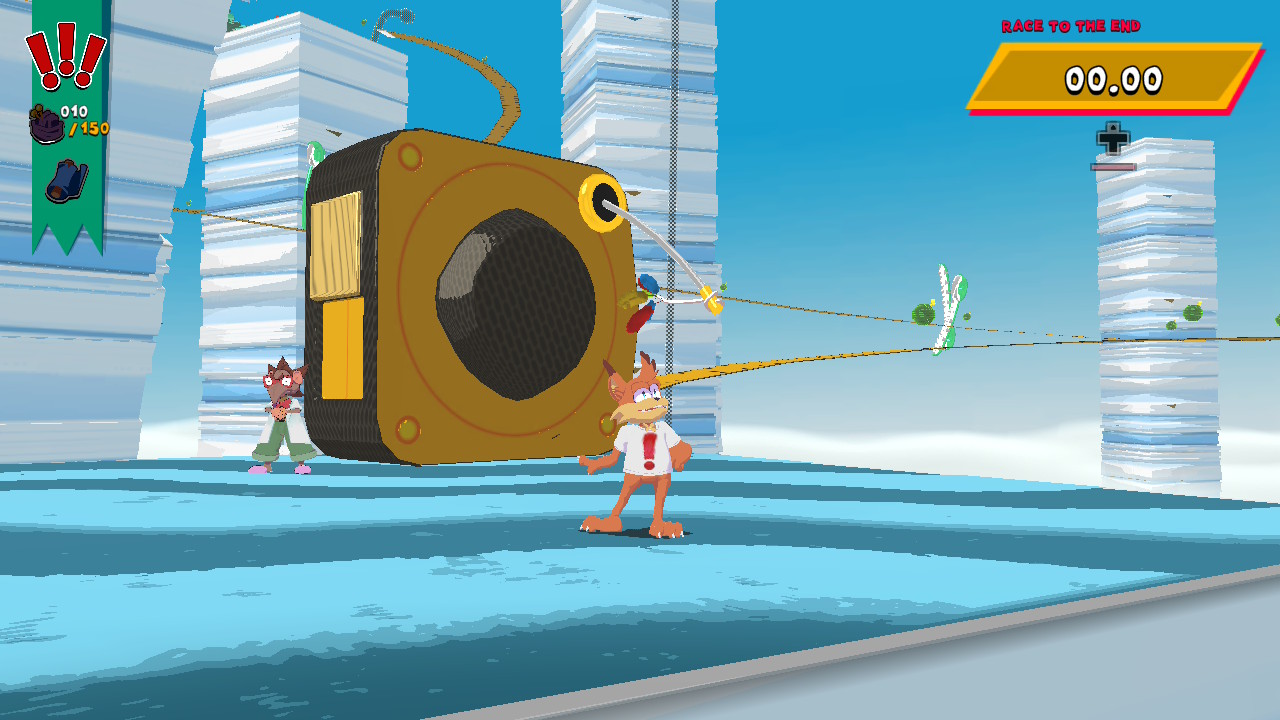
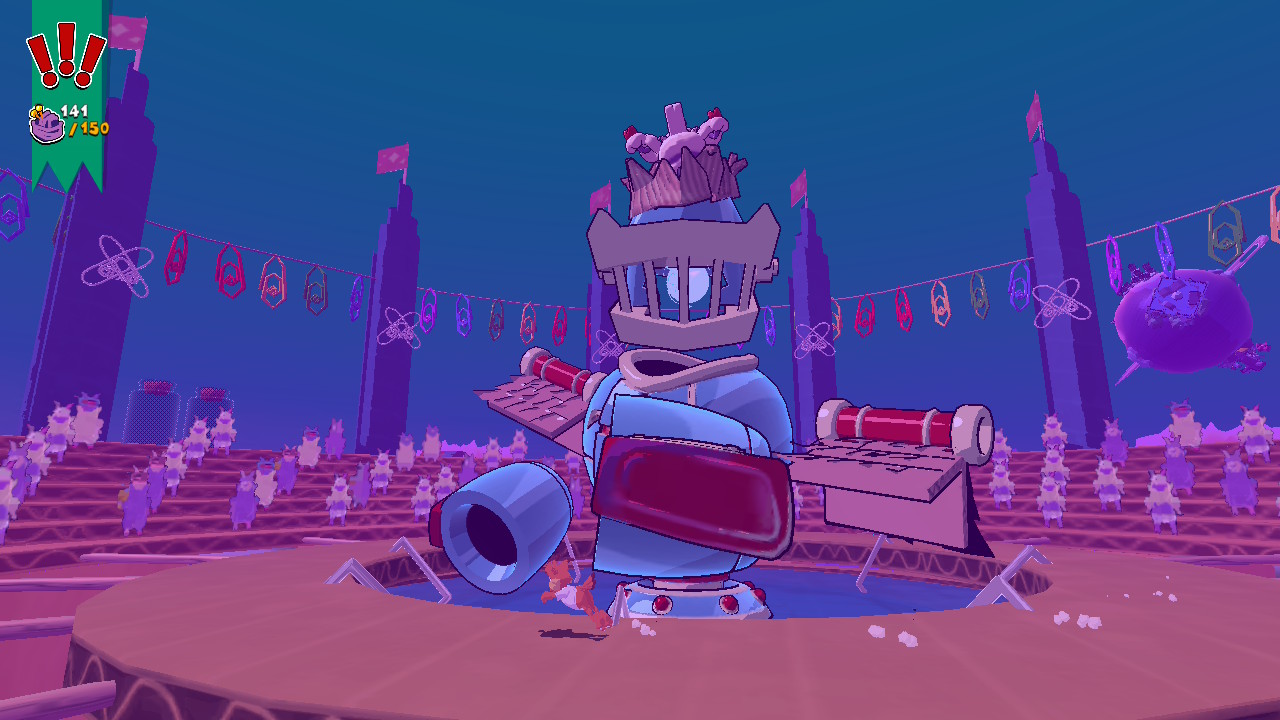
Unlike other entries in the series, in the main gameplay mode, Bubsy 4D doesn’t have a traditional life system and the wise-cracking feline starts off with three hit points. When he is hurt three times, either through falling off a bottomless pit or getting damaged by an enemy, he will respawn at a checkpoint, which thankfully are (kitty) littered across every stage. All three worlds contain five stages, with the fifth being a boss battle against one of the Baabot’s commanders, though these boss stages are still stages to explore with 150 wools to collect.
Bubsy’s suite of abilities this time around includes a new flutter double jump, his returning glide maneuver, and a pounce attack that can be used like a certain blue hedgehog’s homing attack to attack enemies or get through platforming challenges. Baddies that Bubsy goes up against include enemies from the past, like the Woolies and angry cars with faces on them, as well as the Baabots who are armed to the teeth with rayguns and other weapons. A wholly new ability is the new Hairball form, where he inflates himself into a giant orb which can travel along the ground at rapid speed, flatten enemies as well as traverse large half-pipes and tunnels in rapid fashion, which is a really fun mechanic. He can easily swap between it and his other base movement abilities, and you can zip right through a stage if you can flow these moves together. A handy little tidbit for players to know is that Bubsy’s moves can only be used once in succession, but if he pounces on a wall or an enemy, his moves reset and they can be used once more. For later platforming challenges, it is really important to be able to swap between different jumps and pounces to cross long distances. He also has a triple jump, which works identically to that of a well-known mustachio’d plumber (Bubsy himself indirectly references this with a voice impression he does while performing the move) and can run up some walls for a short distance before starting to slide down. He also doesn’t take fall damage like he does in the first Bubsy game. Trust me, that’s a big deal.
To address the bobcat in the room; one of the criticisms of Bubsy as a character in past titles was that he was seen as obnoxious, constantly cracking jokes and running his mouth, which seemed to grate on players after a while. I’m happy to report he is as much a motor-mouth as he ever was. The difference this time around, in my opinion, is that the writing in this game is bloody hilarious. Most of the time it isn’t just a reference for the sake of a reference; in his conversations with his friends, in the observations he makes during stages, or even in what the player chooses to do in the setting menu, he always has something to say and it usually brings about a chuckle. A fun balance to Bubsy’s rapid-fire jokes is how other characters he speaks to talk about him; almost putting him down every chance they get. NPC Woolies can be found in several stages and spoken to – these conversations are without voice acting, but are often still very funny. The writing team and voice actors deserve massive credit because they add a lot of personality to the game, which is one of Bubsy’s most unique traits and it does make him stand out from other mascot characters – aside from a particular gecko, of course, but don’t worry, Bubsy’s nephew and niece remind him of that too. For players who would rather not listen to Bubsy joke every minute, he can be made quip a bit less by a slider in the settings menu, but Bubsy won’t be happy if you do and he’ll let you know about it!
To talk about the sound design and visuals, the game’s SFX are all really solid. They can be overshadowed by Bubsy’s constant chattering, but his jumps and pounces all have a bouncy sound that really emphasize his athleticism and speed. The music is composed by FatBard (of Brawlhalla and Samurai Shodown 2019 fame, amongst other big credits), and they have done a pretty damn good job. The music always manages to match the vibes of the stage or area, with my personal favorite tracks actually being the hub world theme and the final stage BGM. The whole soundtrack is solid and nothing ever stood out as a grating piece; its all good stuff.
In terms of visuals, they are relatively basic, but all feel distinct and unique. My favorite world was definitely the craft-based one; the team got the feeling of being in a world of art equipment and materials down-pat and I got a real kick out of trying to get to the end of a measuring tape before a timer hits 0 and the tape retracts, dumping Bubsy in a bottomless pit. There is a lot of pop-in throughout Bubsy 4D (at least in the Nintendo Switch version), and in a game where you need to be able to see a good distance away to spot ways to reach isolated islands that might contain hidden goodies, this could be off-putting at times, but the areas usually spawned in at a point where I was able to comfortably move forward without much issue.

The big deciding point on if fans are going to want to buy into this game is likely going to be about how they feel about game length. In my personal opinion, if the title is fun, I don’t really care how long it is. The majority of Sonic titles are quite short and it has never been an issue for many as the base of the game is a fun experience, and so long as the stages are fun to replay, I really have no problem. That’s largely how I feel about Bubsy 4D. You can knock it out in just a few short hours, but it is incredibly fun to play and replay over and over again. Some of the pop-in issues and little collision detection problems sometimes hamper the gameplay flow stop it from being a perfect platformer, but considering where Bubsy started off from, and the way that the gaming community sees him, it does make me happy that Fabraz have absolutely nailed this one and given Bubsy’s fans a really fun time. For a mere $20, platforming fans should really try taking a chance on this one. Hey, what could possibly go wrong?
Bubsy 4D copy provided by the publisher for the purposes of this review.


